AI for Product Development: Why Product Managers Are Becoming the Builders
This article is a working example of my Claude Code autoblogging pipeline. It researched the keyword, wrote the draft, and generated the illustrations. I reviewed and edited it, and everything in it is true.
For twenty years, the product manager's job was to describe software that someone else would build. We wrote the specs, drew the wireframes, ran the standups, and waited. The waiting was the job.
Now AI for product development has collapsed that wait from months to days, and something surprising is happening. The people best positioned to take advantage are not the engineers. They're the product managers.
I say this as a product manager who builds. Over the past few months alone, I've shipped a paid calendar app for reMarkable eink devices , a cross-platform metals-price tracker that lives in your menubar, a Chrome extension for tracking prices across any site, a shipping calculator for WooCommerce stores, and the AI pipeline that wrote this very article.
The product manager job was always building without code
Think about what a product manager actually does. You gather ideas and turn them into a vision. You break the vision into requirements. You explain those requirements to developers in precise, unambiguous language. You test what comes back. You decide what ships and what waits. You write the launch copy, brief the marketing team, and watch the metrics after release.
That list is the entire software development lifecycle minus one thing: typing the code.
For decades, that one missing skill kept PMs on the sidelines of building. You could describe the product perfectly and still need to convince an engineering team to make it real. Anyone who has groomed a backlog knows the bottleneck was never ideas. It was always engineering capacity.
AI removed the bottleneck. When you can hand precise instructions to a coding model and get working software back, the skill that matters most is writing precise instructions. PMs have been doing that their whole careers. We just called it a spec.
What AI for product development actually changes
The corporate version of this story is about efficiency. IBM describes AI in product development as a way to accelerate ideation, research, and testing across the whole lifecycle. Kearney goes further, reporting that AI compresses concept-to-market timelines from months into weeks. Those claims match what I see on the ground.
But the deeper change is who gets to participate.
From spec to working prototype
The old flow went idea, spec, mockup, sprint planning, development, QA, release. Each handoff lost information and added weeks. The new flow goes idea, prompt, working prototype, iterate. A PM with Claude Code or Cursor can have a clickable, functional version of a feature before the meeting to discuss the feature would have ended.
That prototype is not a throwaway demo. With review and iteration it becomes the product. I walked through this whole arc in how to launch an app, because building the thing turns out to be the easy part now. Everything around it, the positioning, the pricing, the distribution, is still classic product work.
Testing and iteration at conversation speed
The feedback loop changed too. When a build takes three weeks, you test carefully and batch your changes. When a build takes ten minutes, you test constantly and change one thing at a time. That second mode is exactly how good PMs already think. Hypothesis, experiment, measure, adjust. AI just made the loop fast enough to match the thinking.
Why product managers are built for this moment
Here's the part that should make every PM sit up. The skills that AI cannot replace are the ones product managers have been sharpening for years.
Vision and taste come first. AI will build whatever you ask for, including bad ideas. Knowing what to build, for whom, and why it will win is still a human judgment call. That's product sense, and no model has it.
Then there's writing precise instructions, which is just spec writing wearing a new hat. Prompting a coding agent well looks exactly like writing a good user story. Context, constraints, acceptance criteria. PMs who wrote clear specs for human developers get dramatically better output than people who type "make me an app."
Testing is the same story. AI-generated code works until it doesn't, and someone has to click every button, try the weird edge cases, and refuse to ship until it's right. QA instincts are core PM muscle.
And then someone has to actually sell the thing. A working app nobody hears about is a hobby. PMs already know how to write launch copy, target keywords, and read analytics. The whole second half of building a product was always our half.
This is why I keep arguing that creative technologists should still learn how code works. You don't need to write the code yourself. You need enough fluency to direct the work, smell the problems, and call out the nonsense. That's a director's skill, and it's learnable.
Side projects became the new resume
The AI Product Manager and AI Product Builder titles are spreading across job boards, and companies hiring for them keep asking the same question: what have you built?
Not what have you shipped with a team of twelve engineers. What have you personally built, end to end, with AI tools. The Microsoft and LinkedIn 2024 Work Trend Index found that 66 percent of leaders would not hire someone without AI skills, and 71 percent would rather hire a less experienced candidate with AI skills than a more experienced one without them. For PMs, the way you demonstrate those skills is a portfolio of working software.
That flips the old hierarchy. Experience used to mean years and team size. Now a PM who spent six months of evenings shipping three small AI-built products has more relevant experience than one who spent six years writing tickets for products they never touched.
What a building portfolio looks like
Mine is this website and everything connected to it. I built the site myself with Decap CMS and Eleventy. I built the tools I wanted to exist. Each project taught me something a course never could, like what happens when a coding tutorial goes stale and you have to figure the rest out yourself.
Your portfolio doesn't need to be impressive software. It needs to be real software. A tool that solves one annoying problem for one specific user beats a half-finished clone of a famous app every time. That's product thinking, demonstrated.
The vibe coding caveat
I'm not telling you that prompting equals engineering. I've written before about the limits of vibe coding, and they're real. AI writes code with confidence whether the code is right or wrong. Security, scaling, and maintainability still punish people who don't know what they don't know.
The honest framing is this. AI lets product managers build production-quality small products and convincing prototypes of big ones. For the big ones, you still bring in engineers. But now you arrive with a working prototype instead of a forty-page requirements doc, and the conversation with engineering changes completely. You've already answered the hundred small questions that used to take a quarter of meetings.
PMs who build don't replace engineers. They become better partners to them.
How to start building this week
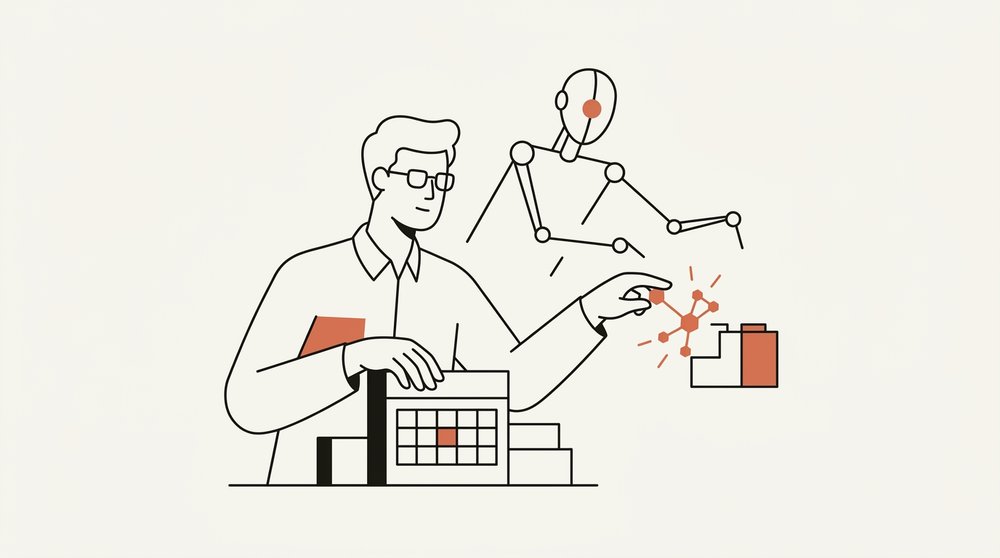
If you're a product manager reading this, the barrier to entry is lower than you think.
- Pick one annoyance. A spreadsheet you update by hand, a report you assemble monthly, a tool you wish existed. Small and specific wins.
- Get a coding agent. Claude Code, Cursor, whatever fits. The subscription costs less than one hour of contractor time.
- Write the spec like you would for a developer. Goal, user, constraints, what done looks like. Then paste it in and start the conversation.
- Test it like a skeptical PM. Break it. Make the AI fix it. Repeat until you'd ship it.
- Ship it publicly. A real URL, a small writeup, a link on your LinkedIn. The publishing is half the value.
Do that five times and you will have an AI product portfolio that most PMs in your interview pool can't match.
Frequently Asked Questions
What is an AI Product Manager?
An AI Product Manager is a product manager who either manages AI-powered products or uses AI tools to build and ship products directly. The second meaning is growing fastest. Companies increasingly expect PMs to prototype and even ship features themselves using AI coding tools.
Do product managers need to learn to code now?
You need code literacy, not code fluency. Understanding how software fits together lets you direct AI tools effectively and catch their mistakes. You don't need to write production code by hand, but you do need to read a file and understand roughly what it does.
Will AI replace product managers?
AI replaces tasks, not judgment. Writing tickets, summarizing feedback, and drafting PRDs are increasingly automated. Deciding what to build, for whom, and when to ship remains human work. PMs who use AI to build will replace PMs who don't.
What AI tools should a product manager start with?
Start with a coding agent like Claude Code or Cursor for building, plus the chat model you already use for research and writing. Add tools as projects demand them. The tool list matters far less than shipping your first real project.
How do I show AI skills on my resume as a PM?
Link to things you built. A live product with a real URL beats any certification line. Describe the problem, the tools, and the outcome in one sentence each. Recruiters hiring for AI PM roles consistently respond to demonstrated building over coursework.
Is AI for product development only for software products?
No. Teams use AI across physical product design, market research, concept testing, and supply chain planning. But software is where an individual PM can go from idea to shipped product alone, which is why it's the fastest way to build proof of skill.